Music Licensing Guidance for Parks & Leagues
A simple starting point for organizations that play commercial music at youth sporting events
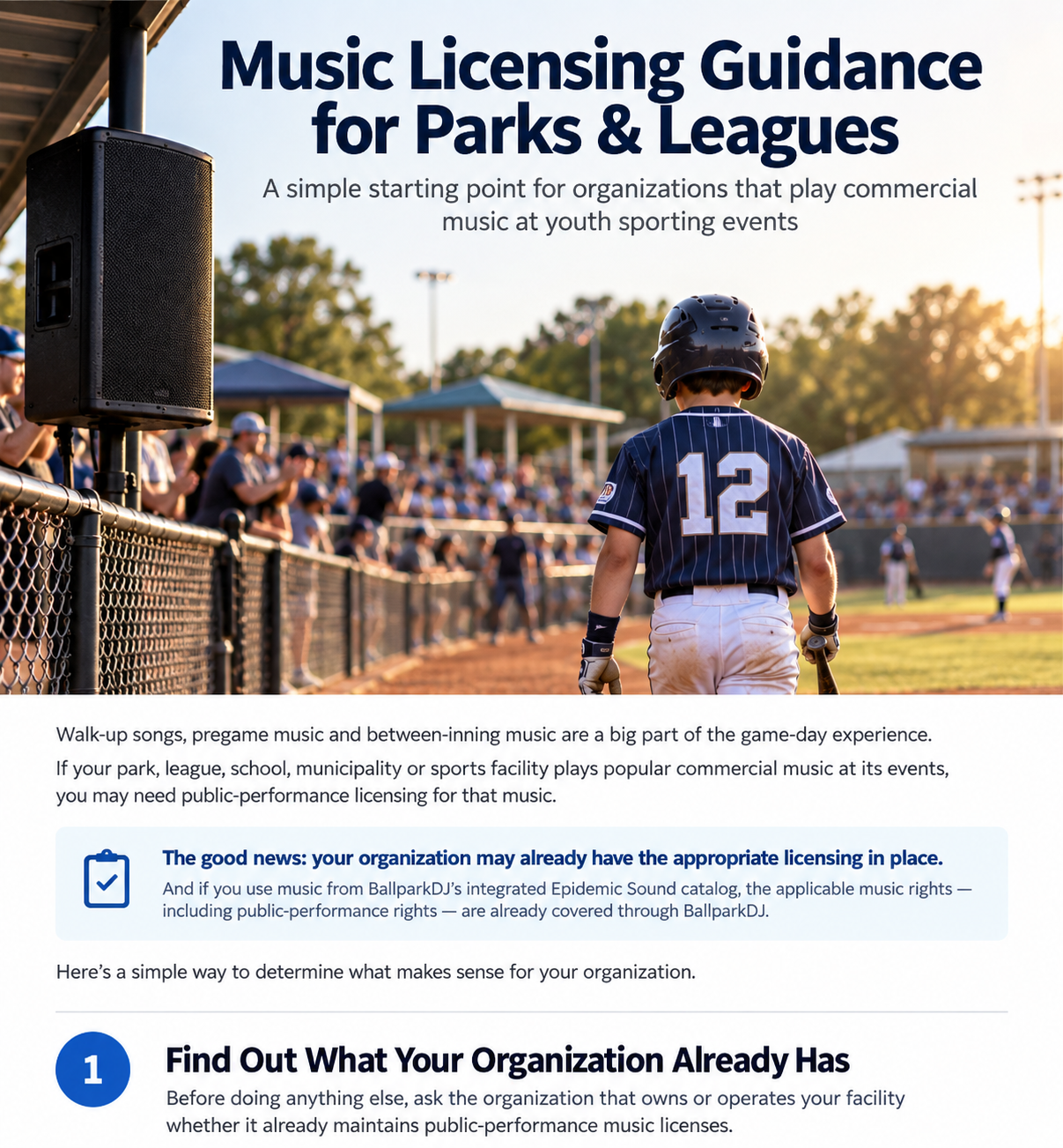
Walk-up songs, pregame music and between-inning music are a big part of the game-day experience.
If your park, league, school, municipality or sports facility plays popular commercial music at its events, you may need public-performance licensing for that music.
The good news: your organization may use rights-cleared music, or may have another lawful basis for particular events. We can’t determine what applies to your specific facility or event, so confirm your coverage with the organization that operates or owns the facility, your licensing representative, or your legal advisor.
But if you use music from BallparkDJ's integrated Epidemic Sound catalog, the applicable music rights — including public-performance rights — are already covered through BallparkDJ.
Here's a simple way to determine what makes sense for your organization.
Step 1: Start with the Music Source
Use BallparkDJ's Fully Licensed Epidemic Sound Music
BallparkDJ has partnered with Epidemic Sound to provide users with an extensive catalog of music where the applicable music rights are already covered through BallparkDJ.
When your teams use music from the Epidemic Sound catalog inside BallparkDJ:
✓ Public-performance rights are covered
✓ BallparkDJ users can play the music at games and events
✓ No separate public-performance license is required for those tracks
✓ No additional music licensing fee is required from the team or individual player
For organizations that want game-day music without having to manage public-performance licensing for those particular tracks, Epidemic Sound provides a simple option directly inside BallparkDJ.
Learn More About Epidemic Sound in BallparkDJ →
… Or Use Your Own Music.
If you have permission, load songs from your school’s band, your player’s bands, or your own band into Apple Music as part of your local library, and use them like you would any other music track.
This gives teams another way to create a unique walk-up moment using music that is personal their players, school, or community.
However, if you want to use popular commercial songs, then proceed to step 2.
Step 2: Find Out What Licenses Your Organization Already Has
Ask the organization that owns or operates your facility whether it already maintains public-performance music licenses.
Depending on your facility, that might be:
Your parks and recreation department
Your city or county
Your school or school district
Your youth sports league
Your tournament organization
Your private sports facility
Many organizations that regularly play music already have licensing arrangements in place. In some communities, a city, county, school district or parks and recreation department maintains blanket music licenses that cover multiple facilities and public parks. Your league may therefore already be covered through the organization that operates the facility. However, blanket licenses may only cover the catalog represented by that particular licensing organization – that is, a blanket license with ASCAP may not include songs that are part of BMI’s catalog.
A good question to ask is simply:
“Do we currently have public-performance music licensing that covers commercial music played at our sporting events?”
If the answer is yes, ask what music and activities are covered. Does it cover recorded music at youth sporting events, including walk-up songs, pregame music, between-inning music, tournaments, and all fields or facilities where music is played? Does it cover live streaming via social media? Does it cover recorded or on-demand video, such as YouTube? And what artists and songs are included in the license? This can help inform you what you can – and can’t – do. A license for public performance may not necessarily include other uses, such as recording videos, posting highlight reels, copying audio files, or syncing music with video, and these may require separate licenses.
Step 3: If Needed, Contact the Music Licensing Organizations
In the United States, public-performance rights for popular commercial music are commonly administered by organizations known as Performing Rights Organizations, or PROs.T
he major organizations include:
ASCAP
ASCAP represents songwriters, composers and music publishers and licenses the public performance of music in its repertory.
BMI
BMI licenses public performances from its catalog and specifically offers licensing for a variety of organizations and facilities, including local governments and athletic activities.
SESAC
SESAC provides public-performance licensing to many types of businesses and organizations, including stadiums, arenas, colleges and other facilities that publicly play music.
Global Music Rights
Global Music Rights, commonly called GMR, represents its own catalog of songwriters and music publishers and offers licensing for uses that include amateur and professional sports as well as municipalities and local government.
Visit Global Music Rights Licensing →
Why Are There Several Licensing Organizations?
Different Performing Rights Organizations represent different songwriters, composers and music publishers.
That means a license from one organization does not necessarily cover music represented by another.
If your facility plays a wide variety of popular commercial music, tell the licensing organizations how you use music and ask what coverage is appropriate for your facility.
You don't need to become a music licensing expert yourself.
Their licensing representatives can help explain the options available to your organization.
Is There One License That Covers Everything?
There isn't a single government-issued music license that automatically covers every commercial song. Different Performing Rights Organizations represent different music catalogs, so organizations that play a wide variety of commercial music may need coverage from multiple PROs.
Some third-party music licensing services can also help organizations coordinate and manage multiple licenses through a single point of contact. If you're unsure what coverage your facility needs, a licensing representative or music-licensing service can help you determine the appropriate approach.
What Information Should We Gather and What Should We Tell Them?
When contacting a music licensing organization, simply explain how your facility uses music.
For example:
“We operate youth baseball and softball fields and play recorded music during games, including player walk-up songs, pregame music and music between innings.”
They may ask for information such as the type of facility you operate, the number of locations or fields, the size of your organization, or how frequently music is played.
From there, they can explain the licensing options that apply to their music catalog.
It may be helpful to gather some basic facts in advance: who owns or operates the fields, how many fields or locations are involved, whether admission is charged, how often music is played (walk-ups, between innings, etc.), whether the sound system covers just the field or other areas (locker rooms, parking lots, concessions, etc.), and whether the game will be broadcast (via the internet, via local radio or community television stations, etc.). Those details help licensing representatives identify the right license type.
Livestreams, recorded videos, highlight reels, and social posts can involve different rights than in-person playback at a field. If your organization wants music for those uses, Epidemic Sound inside BallparkDJ may be the simpler option, while commercial songs may require additional permissions.
Who Should Handle the License?
Public-performance licensing is commonly handled at the facility or organizational level rather than by an individual coach, parent or volunteer Team DJ.
That might be your:
League
Parks and recreation department
School or school district
Municipality
Tournament operator
Facility owner
This also makes sense practically. Coaches, parents and Team DJs change from season to season, while the facility and organization remain.
Our Recommendation
If your organization wants to use popular commercial music at its facilities:
First, find out what licensing you already have.
Start with whoever owns or operates the facility — you may find that the necessary licensing is already handled at the city, county, school district, parks department or facility level.
If you're not currently licensed, contact the relevant Performing Rights Organizations, explain how you use music and let their licensing representatives help you determine the appropriate coverage.
And if you want an option where the applicable music rights are already handled, use music from BallparkDJ's integrated Epidemic Sound catalog.
Questions About Using Music With BallparkDJ?
For a simpler overview of music licensing and how it relates to BallparkDJ, return to our main Music Licensing page.
BallparkDJ Music Licensing Overview →
This information is provided as general guidance to help parks, leagues and organizations understand music licensing, and is not legal advise. Licensing requirements can vary based on the music, venue and manner in which music is used, including live playback, internet streaming or broadcasting, or recorded highlight reels. Organizations with specific legal questions should consult the appropriate licensing organization or their legal advisor.